
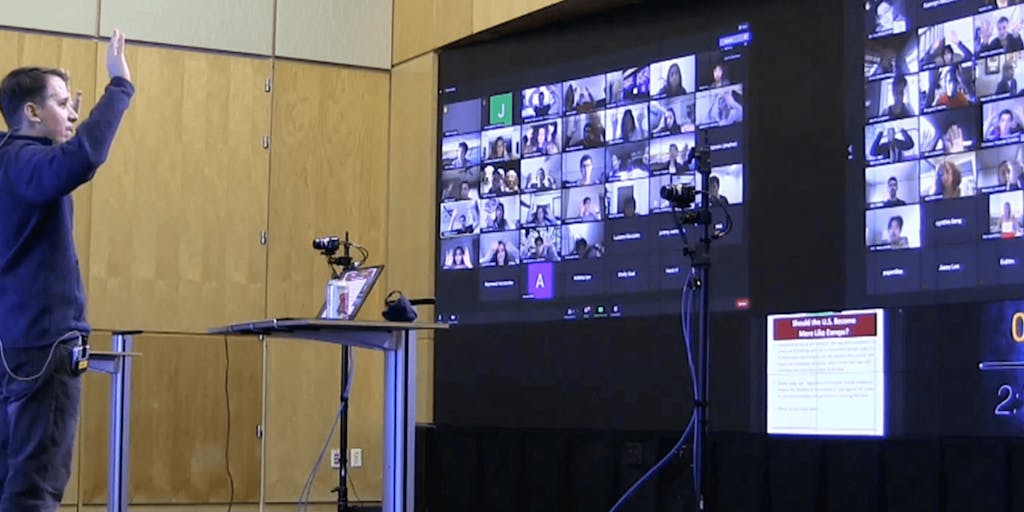
Higher education may never be the same after the COVID-19 pandemic, and that’s true even for the most elite colleges. A group of researchers at Stanford University spent the past year documenting how teaching and student services changed at Stanford during emergency remote learning, and their report, released today, argues that there’s been a shift in the institution’s identity as a result.
Like an A+ student seeking extra credit, Stanford’s research team seemed to attempt to create a more thorough review of pandemic impact than its peers, like Harvard University and MIT, which have issued similar reviews. The 87-page report is informed by interviews with 59 administrators and faculty, as well as a survey of 6,000 students.
The health emergency spread everywhere on the planet, of course, but Stanford had an unusual amount of resources to deploy to respond. And, as the report notes, it is located in Silicon Valley, a short drive from the offices of Zoom, a tool that became the instant online classroom at so many universities, and its administrators knew the company’s leaders well.
Still, like at most colleges, many Stanford professors struggled to adjust to teaching online in the beginning.
“Moving to online was scary for us as faculty,” one Stanford professor, Elizabeth Bernhardt-Kamil, told the report’s authors. “I was certain it was not going to work.” But that professor said she got over that feeling “in about 10 days,” and the report goes out of its way to celebrate experiments and innovations in teaching developed while campus was closed, some of which have led to lasting changes in teaching and attitudes.
Students, too, found it challenging to adapt to virtual instruction. Nearly 80 percent of students surveyed by the university said they found it difficult to focus during online instruction. And with the campus closed, access to instruction became uneven for different kinds of students. For instance, 45 percent of first-generation and low-income Stanford students reported that they did not have a productive place to study and work, while only 25 percent of other students reported that as an issue.
Some professors at Stanford responded by “chunking” their courses into smaller segments, mixing shorter lectures with more active discussions or activities. Others tried to do more experiential education, such as mailing activity kits to students to, say, do a bridge-design experiment out of household materials. And many others adopted a “flipped classroom” approach where students watched lecture videos as homework and then used class time on Zoom to discuss the material. Professors also spent more time rethinking their teaching practices, and joining Slack groups and other online professional discussions about how to make their teaching more engaging, the report says. And some tried involving students in teaching in new ways, asking some to serve as peer advisors or to help with class-related technology.
“What we’re trying to do is document and develop a shared narrative,” Matthew Rascoff, Stanford’s vice provost for digital education who led the review, told EdSurge in an interview this week.
Rascoff said the biggest surprise was how the pandemic awakened faculty to be more empathetic to the diverse experiences of their students and think more intentionally about student wellness as well as academic concerns.
“That’s not usually seen as the province of digital learning,” he said. “That is one of the unforgettable lessons that won’t be unlearned. Technologists need to be given the mandate that they can design for the whole students.”
Innovation, and Intrusion
One small tactical example is that professors have gotten in the habit of doing a one-question poll at the beginning of class to see how students are doing, said Cynthia Berhtram, an associate director of project management who co-authored the report. “There has been a mindset change, and mindsets also are not unlearned,” she added. “If faculty view student wellbeing as part of the responsibility of being an instructor of record, I don’t think that is unwound.”
At times, the same tech that helped the university continue its instruction also posed challenges to student well-being, however, the report found: “Some instructors and staff felt there was an erosion of trust between students and the institution, a widespread shift in our society many told us began before the pandemic. In academia, this shift has led to an increased hesitancy to broach potentially controversial or challenging subjects—of which there were many during the pandemic.” The “intrusion” of technology, the report added, meant that class discussions could be recorded on Zoom, which could help others in class see them later, but also created the possibility that a moment in a class discussion on a sensitive topic could be shared more widely.
The report comes in the same week as new data shows that traditional colleges saw another decline in enrollment in the past year, dropping 1.1 percent since last fall. That’s on top of a 6.5 percent decline in enrollment earlier in the pandemic, according to the data from the National Student Clearinghouse. That decline has come primarily in community colleges, however, and Stanford and other highly-selective colleges have seen a steady increase in applications, even during pandemic disruptions.
Still, even a place like Stanford can’t ignore the growing skepticism of higher education in general, and the sense, amplified by the pandemic, that college instruction can happen even without a campus, Rascoff acknowledged.
He sees potential opportunities for Stanford to try to expand access to its offerings now that more online capacity has been developed, though he says it’s too early to say whether Stanford would consider doing something like offering an online bachelor’s degree.
“No one would argue that online is a full replacement for the in-person campus,” he said.


