
Robot delivery has long been touted as a game-changing technology of the future. However, it still hasn’t cracked the big time. Drones still aren’t airdropping packages into our gutters by accident, nor are our pizzas brought to us via self-driving cars.
That’s not to say that able minds aren’t working on the problem. In one case, a group of engineers are working ton a robot that will handle the crucial duty of delivering food to hungry flyers at the airport.
Tacos To Gate 37, And Step On It!
Eating at the airport can be a bit of a crapshoot. Seating is usually limited, with thousands upon thousands of people passing through in any given day. Even if you get to the airport early, you might struggle to find somewhere to sit down and eat. Get there late, or get a bad security line, and you might not have time to order food before you need to walk to your gate. Airports are typically large, sprawling complexes, and the food outlet you desire may be on the opposite side of the building to where you’re boarding your plane.
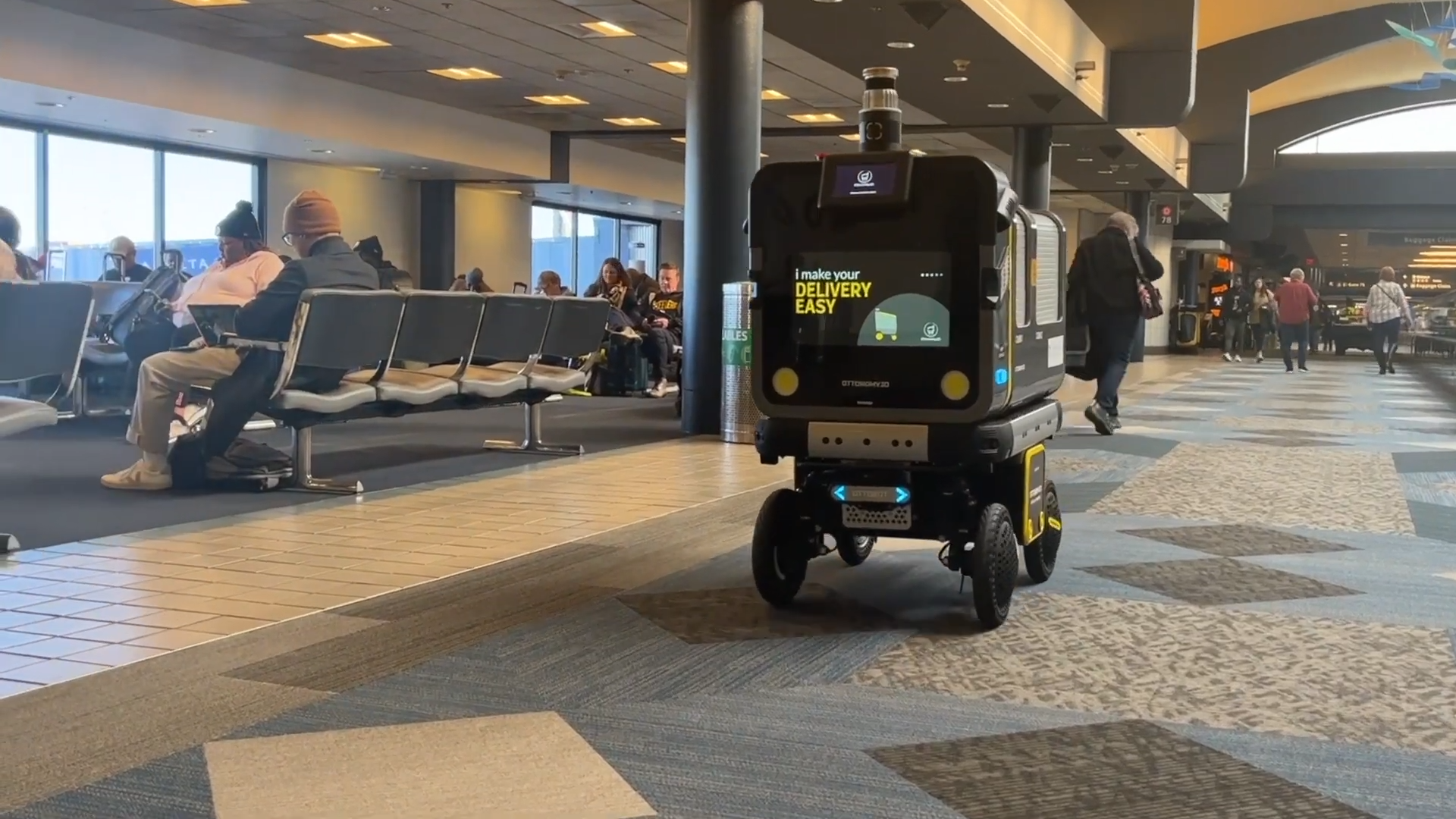
Robot delivery could potentially solve these issues by delivering food directly to passengers at the gate. It’s this problem that robotics startup Ottonomy set out to solve, working in partnership with Cincinnati/Northern Kentucky Airport.
In the cluttered, indoor environment of an airport, GPS and other satellite constellations simply aren’t usable for navigation. Instead, Ottonomy’s Ottobot relies on lidar, cameras, and ultrasonic sensors to detect obstacles and find its way around the environment. The company created proprietary software for mapping indoor environments, in order to give its robots the necessary 3D map to get around their workspace.
Airports can get incredibly crowded, and early on, the team found that navigation in these situations was difficult. This led to the Ottobot’s current configuration, in which every wheel is motorized and capable of steering. This lets the robot crab sideways, execute a zero-radius turn, or tightly swerve around corners, both of which are useful to get around tight spaces. The drivetrain was inspired by electric wheelchairs. Just like an electric wheelchair, the Ottobot needs a tight turning circle and the ability to deal with lumps, bumps and kerbs, at times.
Several compartments on the bot are used to store various items a customer might order. As is becoming common in food delivery, this would allow the necessary separation of cold drinks and hot food, for example. The Ottobot is also capable of raising and lowering its ride height. It might seem like a curious feature, but it helps the robot serve a greater range of customers. The robot can lower itself down to allow a child to pickup an order, or raise itself to help a customer that can’t easily bend over. Notably, the company has kept the cabin design modular so that it can be customized by end-users to suit different delivery roles.
As with most any autonomous system humans have ever built, there’s always a risk that things will go wrong. In the event that an Ottobot can’t figure out where it is or where it’s going, staff can take over control to get the robot out of trouble. This feature is particularly useful if the robot finds itself in an unexpected situation. The robots also feature a “How Am I Driving?” sticker on the back, that invites feedback on the robots performance.

The order process relies on an app called Crave. Customers can scan a QR code at their gate or at the restaurant location itself, and then place an order through the app. Rather than putting in their home address, the customer then provides their desired delivery location in the airport, such as their gate number. When the food is ready, it’s loaded into the robot by the restaurant, and then the robot heads off to find the customer. According to Ottonomy, deliveries can be as quick as 10 minutes for orders of retail snacks, or 20 to 25 minutes for those that are freshly prepared by a restaurant.
The robots are being rolled out to several locations for testing, with a pilot program at Rome Airport among various future deployments. The robots were also recently tested at Pittsburgh International Airport, with passengers offered a free drink for helping to trial the system.
Ottonomy obviously isn’t the only company in the robot delivery space. Other notable competitors we’ve seen before include Neubility, LG, and Baemin. It’s interesting to note that many of these companies have converged on similar designs. These robots typically feature the same kinds of sensor packages, drive systems, and overall layouts. The vast majority resemble a cooler on wheels that’s designed to be highly maneuverable and handle regular urban terrain. When your rivals have come up with similar solutions, it can be a sign that you’re on the right track.
Overall, airport food delivery seems like an achievable challenge for robotics startups to solve. In relatively-controlled spaces like airports, the risks are low. With the right packaging choices, the smell from potent curries shouldn’t pollute another customer’s salad. An integrated system for customers to report problems should allow any messy robots to be readily sent back for cleaning in the event of spills, too.
A slow robot with enough sensors not to run over people shouldn’t have too much trouble delivering some food from point A to point B. Perhaps the most likely problem is that the robots will be unable to handle navigating around an airport when passenger volumes are highest. Heavy foot traffic would slow deliveries in these conditions, which would also be when demand is highest. And of course, the time to get back from point B to point A also has to be factored in to every delivery.
At the extremes, if the robots become completely unable to move, they could become frustrating roadblocks for passengers in a hurry. Stress testing a robot delivery system would be ideal, but it’s hard to imagine any artificial test measuring up to the sheer havoc and chaos of Thanksgiving weekend at LAX.
In any case, it seems likely that robot delivery will gradually become more common as the technology matures and kinks are worked out. Get familiar with your robot delivery pals, and be friendly, lest they shake up your soda by using their lidar to find a particularly rough bit of pavement just to spite you!


